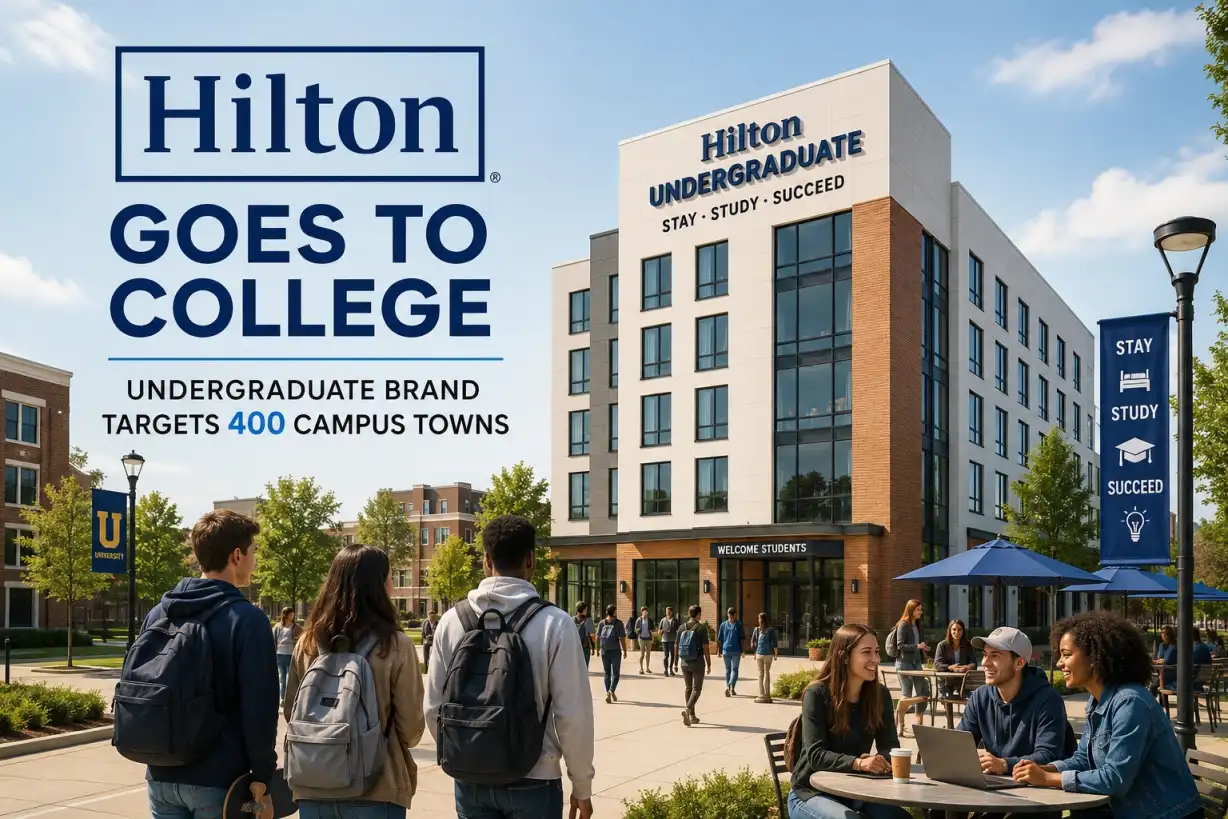
Hilton Goes to College: Undergraduate Brand Targets 400 Campus Towns

College towns have always had a hotel problem. Demand spikes hard around move-in weekend, homecoming, graduation and big football Saturdays, then goes quiet for long stretches in between. Most national hotel brands have treated that boom-bu...

Published Jul 03, 2026
5 min read
Share:
McLean, Virginia — July 2026

College towns have always had a hotel problem. Demand spikes hard around move-in weekend, homecoming, graduation and big football Saturdays, then goes quiet for long stretches in between. Most national hotel brands have treated that boom-bust rhythm as a reason to stay away, or at best to plant a standard limited-service property a few miles from campus and call it done. Hilton is now betting that the right brand, built specifically around that rhythm, can turn it into an advantage instead of a liability.

The company announced Undergraduate by Hilton this spring, an upper-midscale brand aimed squarely at university markets. Hilton has pegged its long-term potential at 400 to 500 hotels, an ambitious number for a brand that hasn't opened its first property yet. That debut hotel is expected in 2027, according to Hilton's own announcement and coverage from Hotel Dive and Lodging Magazine.

Chris Nassetta, Hilton's president and chief executive, framed the launch as both a growth play and a positioning move. "Undergraduate by Hilton unveils an exciting new era of college-town hospitality, expanding how we show up for campus-connected travelers – offering more stay options while supporting disciplined, long-term growth across our portfolio," Nassetta said in the company's announcement. He added that the idea grew out of a specific gap Hilton saw in its own map: "We saw a clear opportunity to bring the energy, design and experiences people love about campus communities to more university towns with this new brand."

That gap sits between Hilton's existing Graduate by Hilton, an upper-upscale brand that has built a cult following for its campus-nostalgia design and now operates in more than 30 college markets, and the mainstream limited-service brands like Hampton or Hilton Garden Inn that could theoretically go anywhere. Undergraduate is meant to occupy the space in between: lifestyle-forward enough to feel distinct, but priced and built to work economically in smaller university towns that couldn't support a Graduate-tier project.

Chris Silcock, Hilton's president of global brands and commercial services, tied the launch to a generational shift in what younger travelers expect from a hotel stay. "We're continuously evolving how we connect with the next generation of travelers by creating new ways to stay within the places that matter most to them," Silcock said. "With Undergraduate by Hilton, we're broadening the stay experiences we offer, pairing community-led experiences with the scale of Hilton's global platform to expand choice and deliver long-term value for owners."

The design brief, as described in Hilton's release and picked up by outlets including Hospitality Design and Travel And Tour World, leans hard into the campus metaphor. Guest rooms are meant to evoke classrooms, complete with a dedicated study corner and extra storage space — useful, presumably, for parents dropping off or picking up students with a car full of belongings. Public areas are designed as lounges and library-style spaces meant to double as informal gathering spots for guests, locals and students alike, plus a barista-led market for coffee and quick food. Hilton describes the goal as making each property feel like "an always-on, off-campus hangout," a phrase that shows up across the brand's marketing materials.

Just as important as the design is who Hilton expects to walk through the door. The brand isn't being built solely for parents on move-in weekend. Hilton's own materials list students, locals, alumni, sports fans, and business or conference travelers among the target guests, a mix meant to keep occupancy from collapsing the moment the academic calendar goes quiet. College towns that host Big Ten or SEC football, active alumni networks, or year-round conference and camp business are the kind of markets Hilton is describing when it talks about "consistent, year-round demand tied to tours, athletic weekends and campus gatherings."

For developers, the pitch centers on flexibility. Undergraduate is designed to support both ground-up construction and conversions of existing buildings, which lowers the barrier to entry compared with a brand that only works as new construction. That matters in college towns, where good sites near campus are often already occupied by aging hotels, extended-stay properties or even off-campus housing that could, in theory, be repositioned. A conversion path lets Hilton move faster and lets owners avoid the cost and permitting headaches of a ground-up build.

The timing lines up with a broader wave of brand fragmentation across the industry, something Hotel Dive and other trade outlets have tracked closely this year. Hilton alone has introduced or previewed several narrowly targeted brands in a short window — Apartment Collection for furnished, extended-stay units, Outset Collection for boutique upscale hotels, and now Undergraduate for university markets. Each is chasing a specific demand pattern that a generic limited-service brand can't fully capture, and each gives Hilton another flag to plant before a competitor gets there first.

Whether Undergraduate hits anywhere near its stated ceiling of 400 to 500 hotels will hinge on how quickly Hilton can sign development deals and how convincingly the brand delivers on its lifestyle promise once the first property actually opens its doors in 2027. Brand launches are easy; filling a pipeline with real signed deals is the hard part, and Hilton has both succeeded (Home2 Suites, Tru) and moved more slowly than promised (some of its earlier lifestyle brands) on that front before.

Still, the logic behind targeting college towns is hard to argue with. There are more than 4,000 degree-granting institutions in the U.S., many surrounded by towns that punch above their weight in event-driven travel demand but well below it in quality lodging supply. If Hilton can make the economics work in even a fraction of those markets, Undergraduate could end up being one of the more consequential brand launches of the year — not because of glossy design renderings, but because of the sheer number of towns that might finally get a hotel built specifically for how they actually fill rooms.

HospitalityAxis news delivered to your inbox

Get the free newsletter that keeps hotel developers & designers ahead of the curve.

More News & Articles

Latest Story

Deloitte's New Travel Report Has a Warning for Airlines and Hotels: The Road Warriors Are Slowing Down

The travelers airlines and hotels have relied on most heavily to prop up premium revenue may be losing some of their frequent-flyer stamina.That's the takeaway from Deloitte's 2026 Travel Industry Outlook and the accompanying Corporate Traveler Survey data behind it, which point to a meaningful cooling among the road warriors who take ten or more business trips a year. According to the survey, 53% of these frequent corporate travelers said they expected to travel three or more times in a typical month in 2026, down from 63% who said the same heading into 2025. That's a ten-point drop in a single year among precisely the travelers whose habits matter most to airline and hotel bottom lines.The reason that particular statistic matters so much comes down to spending patterns. Frequent corporate travelers, like their higher-income leisure counterparts, are disproportionately likely to book premium seats, upgraded rooms and other higher-margin products. Deloitte's report warns that if this group pulls back even modestly on both trip frequency and premium spending in 2026, the travel categories that benefited most from post-pandemic upgrade behavior "may be particularly exposed."Airlines, in particular, have leaned hard into premium cabin sales over the past several years as a source of outsized margin growth, often outpacing growth in coach revenue. Deloitte's report suggests that momentum could soften or plateau in the year ahead, which would put more pressure on carriers to get sharper about targeting the right offer to the right flyer at the right moment rather than counting on broad-based upgrade demand to keep flowing in. The hotel side faces a parallel risk: midscale and upscale resorts and city hotels could see occupancy or rate erosion if higher-income and frequent business travelers become more deal-sensitive, shorten the length of their stays, or simply take fewer trips altogether.Behind the specific travel numbers sits a broader story about consumer psychology that Deloitte's researchers describe as a widening financial split among Americans. Financial pessimism, historically concentrated among lower- and middle-income households, has crept up into higher income brackets in a way that's more pronounced than in recent years. That's producing what the report calls a growing wealth bifurcation in how people plan and pay for trips, business and leisure alike. Even affluent, frequent travelers who have the means to keep booking premium options at their prior pace appear to be second-guessing whether they should.Harvey Chipkin, writing about the findings for Business Travel Executive, summarized the risk bluntly: corporate travel may be slowing down "among highly desirable road warriors," the exact segment that travel brands have spent years building loyalty programs and premium products specifically to retain. If that segment's travel cadence keeps drifting downward, the loyalty economics that airlines and hotel chains depend on to justify premium investment could come under real strain.None of this amounts to a wholesale collapse in business travel demand, and Deloitte's broader outlook doesn't read as bearish so much as cautious. Travel remains a clear spending priority for both companies and individual American travelers, according to the report. The concern Deloitte raises isn't that people will stop traveling for work altogether, but that the growth engine that has powered the post-pandemic recovery, driven substantially by high-frequency, high-spend travelers trading up to premium products, may be running out of room to keep accelerating at the same pace.That has real implications for how airlines and hotel companies plan their next year. Deloitte's report flags competition for high-spending travelers as likely to intensify even as the overall pool of easy upgrade revenue shrinks. Ultra-luxury demand appears to be holding up better than the broader premium segment, the report notes, but airlines and hotels may need to work harder and spend more on precise targeting to capture affluent travelers who have become pickier, more price-conscious, or simply willing to trade down on any given trip.The generational makeup of who's actually driving travel demand is shifting too, according to Deloitte's outlook, and that shift carries its own implications for corporate travel programs. Gen Z and Millennials are now described in the report as defining the center of U.S. travel demand overall, shaping everything from which booking channels get used to what travelers expect from sustainability practices and how they define value versus luxury. Those two generations have kept traveling at a relatively steady clip even during periods of softer demand elsewhere, the report notes, which Deloitte suggests will increasingly influence how travel brands design products and market to travelers going forward, corporate travelers very much included as younger employees move into roles that require more business travel.Artificial intelligence is the other undercurrent running through Deloitte's 2026 outlook, and it intersects directly with how corporate travel gets booked and managed. The report describes this as a moment when generative AI tools are starting to reshape how travelers discover and purchase trips, even though fully integrated AI-powered booking experiences are still more emerging than mainstream. Deloitte frames 2026 as a potential turning point for how personalization and merchandising work in travel, a dynamic that overlaps closely with what corporate travel platforms and managed travel programs are simultaneously trying to build into their own booking tools.For corporate travel managers and the suppliers who serve them, Deloitte's report functions less as a warning of imminent disaster and more as an early signal to watch closely. A ten-point drop in the share of frequent travelers planning to hit the road three-plus times a month is not, by itself, a crisis. But it's exactly the kind of leading indicator that tends to show up in loyalty program engagement and premium cabin load factors before it shows up in headline revenue numbers. If the caution Deloitte is describing among affluent and frequent travelers persists through the rest of 2026, airlines and hotel companies that built recent growth strategies around premium upsells may need to recalibrate faster than they'd planned, precisely at a moment when GBTA's own buyer surveys suggest overall corporate travel budgets are still expected to hold steady or grow. The two data sets aren't necessarily in conflict, but they do describe an industry where the money keeps flowing while the travelers who spend it most aggressively are starting to hesitate.

Jul 03, 2026