Newsroom

Business Travel News Category Archive

Hospitality Business Travel

Business Travel Jul 03, 2026

Deloitte's New Travel Report Has a Warning for Airlines and Hotels: The Road Warriors Are Slowing Down

The travelers airlines and hotels have relied on most heavily to prop up premium revenue may be losing some of their frequent-flyer stamina.That's the takeaway from Deloitte's 2026 Travel Industry Outlook and the accompanying Corporate Traveler Survey data behind it, which point to a meaningful cooling among the road warriors who take ten or more business trips a year. According to the survey, 53% of these frequent corporate travelers said they expected to travel three or more times in a typical month in 2026, down from 63% who said the same heading into 2025. That's a ten-point drop in a single year among precisely the travelers whose habits matter most to airline and hotel bottom lines.The reason that particular statistic matters so much comes down to spending patterns. Frequent corporate travelers, like their higher-income leisure counterparts, are disproportionately likely to book premium seats, upgraded rooms and other higher-margin products. Deloitte's report warns that if this group pulls back even modestly on both trip frequency and premium spending in 2026, the travel categories that benefited most from post-pandemic upgrade behavior "may be particularly exposed."Airlines, in particular, have leaned hard into premium cabin sales over the past several years as a source of outsized margin growth, often outpacing growth in coach revenue. Deloitte's report suggests that momentum could soften or plateau in the year ahead, which would put more pressure on carriers to get sharper about targeting the right offer to the right flyer at the right moment rather than counting on broad-based upgrade demand to keep flowing in. The hotel side faces a parallel risk: midscale and upscale resorts and city hotels could see occupancy or rate erosion if higher-income and frequent business travelers become more deal-sensitive, shorten the length of their stays, or simply take fewer trips altogether.Behind the specific travel numbers sits a broader story about consumer psychology that Deloitte's researchers describe as a widening financial split among Americans. Financial pessimism, historically concentrated among lower- and middle-income households, has crept up into higher income brackets in a way that's more pronounced than in recent years. That's producing what the report calls a growing wealth bifurcation in how people plan and pay for trips, business and leisure alike. Even affluent, frequent travelers who have the means to keep booking premium options at their prior pace appear to be second-guessing whether they should.Harvey Chipkin, writing about the findings for Business Travel Executive, summarized the risk bluntly: corporate travel may be slowing down "among highly desirable road warriors," the exact segment that travel brands have spent years building loyalty programs and premium products specifically to retain. If that segment's travel cadence keeps drifting downward, the loyalty economics that airlines and hotel chains depend on to justify premium investment could come under real strain.None of this amounts to a wholesale collapse in business travel demand, and Deloitte's broader outlook doesn't read as bearish so much as cautious. Travel remains a clear spending priority for both companies and individual American travelers, according to the report. The concern Deloitte raises isn't that people will stop traveling for work altogether, but that the growth engine that has powered the post-pandemic recovery, driven substantially by high-frequency, high-spend travelers trading up to premium products, may be running out of room to keep accelerating at the same pace.That has real implications for how airlines and hotel companies plan their next year. Deloitte's report flags competition for high-spending travelers as likely to intensify even as the overall pool of easy upgrade revenue shrinks. Ultra-luxury demand appears to be holding up better than the broader premium segment, the report notes, but airlines and hotels may need to work harder and spend more on precise targeting to capture affluent travelers who have become pickier, more price-conscious, or simply willing to trade down on any given trip.The generational makeup of who's actually driving travel demand is shifting too, according to Deloitte's outlook, and that shift carries its own implications for corporate travel programs. Gen Z and Millennials are now described in the report as defining the center of U.S. travel demand overall, shaping everything from which booking channels get used to what travelers expect from sustainability practices and how they define value versus luxury. Those two generations have kept traveling at a relatively steady clip even during periods of softer demand elsewhere, the report notes, which Deloitte suggests will increasingly influence how travel brands design products and market to travelers going forward, corporate travelers very much included as younger employees move into roles that require more business travel.Artificial intelligence is the other undercurrent running through Deloitte's 2026 outlook, and it intersects directly with how corporate travel gets booked and managed. The report describes this as a moment when generative AI tools are starting to reshape how travelers discover and purchase trips, even though fully integrated AI-powered booking experiences are still more emerging than mainstream. Deloitte frames 2026 as a potential turning point for how personalization and merchandising work in travel, a dynamic that overlaps closely with what corporate travel platforms and managed travel programs are simultaneously trying to build into their own booking tools.For corporate travel managers and the suppliers who serve them, Deloitte's report functions less as a warning of imminent disaster and more as an early signal to watch closely. A ten-point drop in the share of frequent travelers planning to hit the road three-plus times a month is not, by itself, a crisis. But it's exactly the kind of leading indicator that tends to show up in loyalty program engagement and premium cabin load factors before it shows up in headline revenue numbers. If the caution Deloitte is describing among affluent and frequent travelers persists through the rest of 2026, airlines and hotel companies that built recent growth strategies around premium upsells may need to recalibrate faster than they'd planned, precisely at a moment when GBTA's own buyer surveys suggest overall corporate travel budgets are still expected to hold steady or grow. The two data sets aren't necessarily in conflict, but they do describe an industry where the money keeps flowing while the travelers who spend it most aggressively are starting to hesitate.
Read Story
Business Travel Jul 03, 2026

Navan Went Public Promising to Fix Business Travel. Wall Street Is Still Deciding If It Believes That.

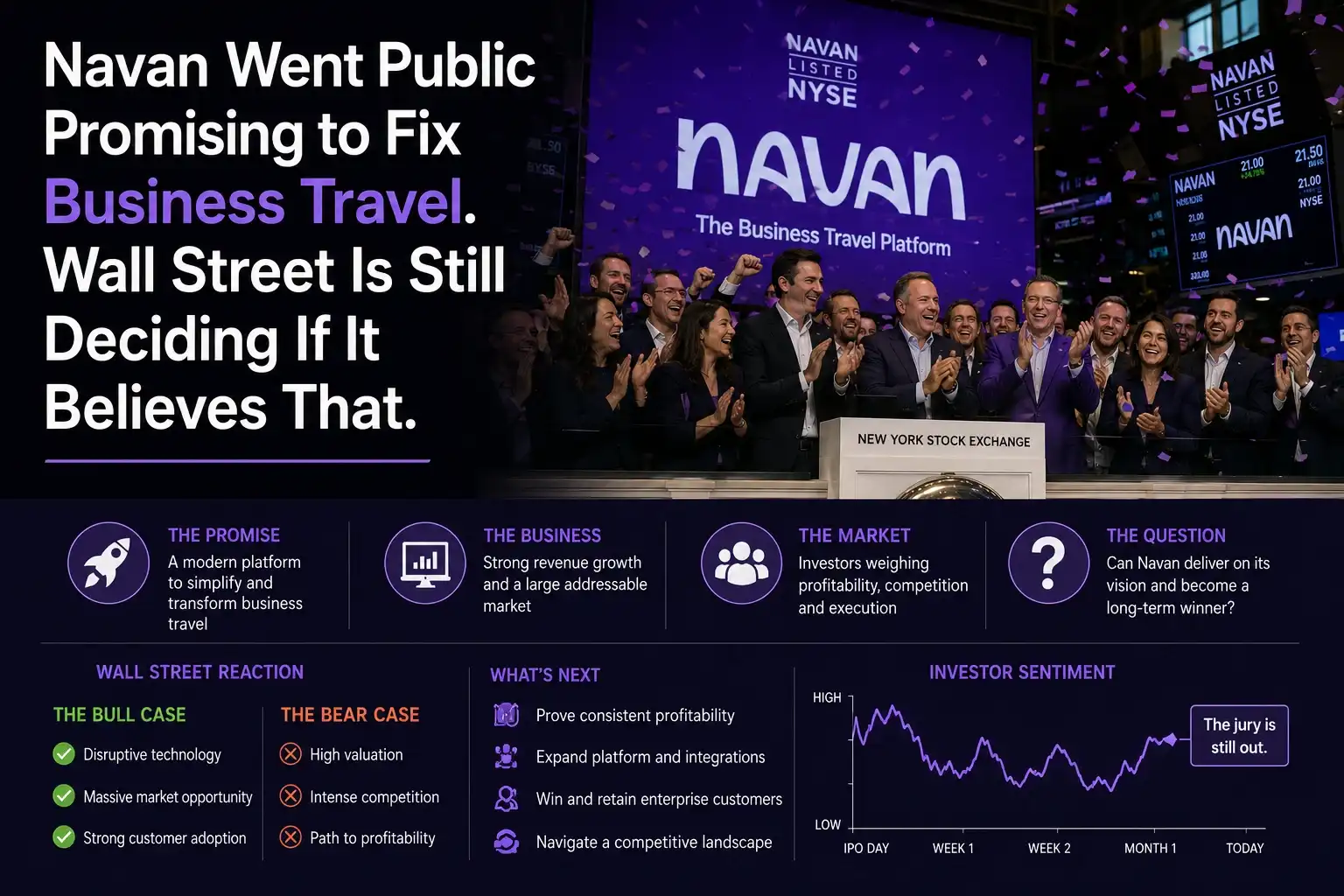
For a company built on the promise of eliminating friction from business travel, Navan's own path to Wall Street has been anything but frictionless.The Palo Alto-based company, known for most of its existence as TripActions, filed to go public in September of last year and priced its initial public offering on October 31 at $25 per share, raising $923.1 million in what ranked among the largest U.S. technology listings of the year. The company listed on the Nasdaq Global Select Market under the ticker NAVN, with Goldman Sachs and Citigroup serving as lead underwriters. It was, by any measure, a marquee debut for a startup that had spent nearly a decade building itself into one of the more recognizable names in corporate travel management.The financial picture Navan presented to investors was one of a company still growing quickly but not yet profitable. Revenue over the trailing year came in at $613 million, up 32%, alongside $7.6 billion in total bookings, an increase of 34%. The company counts more than 10,000 corporate clients, including household names like Adobe, Blue Origin, Geico and Unilever. Net losses totaled $181 million for the fiscal year, roughly half of what the company lost the year before, though losses in the most recent six-month stretch actually ticked back up to $100 million. Gross margins told a more encouraging story, climbing from 60% to 68% year over year, a sign that the underlying unit economics of the business are improving even as the company continues to spend heavily on growth.Since that October debut, though, the stock has had a rough go of it. Shares that priced at $25 traded as low as $9.20 in early 2026, a decline of nearly 63% from the offering price. That kind of drop for a company that had been valued at roughly $9.2 billion in its last private funding round raises an obvious question: does Wall Street actually believe in the vision Navan is selling, or was the IPO simply well-timed to catch a moment when tech listings were back in fashion?The company's own answer, laid out in the letter that co-founders Ariel Cohen and Ilan Twig wrote to prospective investors in the IPO filing, leans heavily on the idea that Navan solves a genuinely painful problem. "We built Navan for the road warriors, for CEOs and CFOs who understand travel's critical importance to their strategy, for finance teams who demand precision and control, and for the assistants and program managers ensuring seamless events," they wrote. Cohen and Twig founded the company in 2015 with an explicit goal of building an alternative to legacy corporate travel and expense software, most notably SAP Concur, which has long dominated the category despite widespread complaints from users about clunky booking flows and disconnected expense systems.Technology is central to how Navan pitches itself as different. The company has built a virtual assistant called Ava that now reportedly handles roughly half of all customer service interactions, reducing the need for human agents in what has traditionally been a labor-intensive part of the travel management business. Underpinning that is what the company calls its Navan Cognition framework, which it says powers both expense compliance checks and predictive travel recommendations. The pitch to investors is that owning this technology stack, rather than stitching together third-party tools, gives Navan an edge over both old-guard incumbents and a crowd of newer challengers that includes TravelPerk, Brex and Ramp.That competitive landscape has only gotten more crowded and more consolidated in the months since Navan's filing. TravelPerk itself has been on an acquisition spree, rebranding to simply "Perk" after buying expense management company Yokoy, while a separate deal saw S4BT acquire HotelHub to create what's being described as a $5 billion corporate hotel booking platform. The broader corporate travel technology market, in other words, is going through a wave of consolidation at the exact moment Navan is trying to prove out its standalone public-company story.Navan's IPO also arrived in the middle of a broader thaw in the market for tech listings after several sluggish years. High-profile debuts from companies like Klarna, Figma and StubHub had already reopened the door for growth-stage companies to test public markets, and crypto exchanges Circle and Gemini followed with their own listings around the same period. For Navan's backers, a group that includes Andreessen Horowitz, Coatue, Lightspeed and Goldman Sachs, and which collectively poured more than $1.5 billion into the company over its history, the IPO represented a chance to finally convert years of venture funding into a liquid, publicly traded stake.Whether that bet pays off longer term may hinge less on travel bookings and more on how successfully Navan expands beyond its original category. The company has made no secret of its ambitions in payments and financial automation, positioning itself not just as a travel booking tool but as a broader platform for enterprise spending management. That's the same territory Ramp and Brex are chasing from the fintech side, meaning Navan's long-term success may ultimately be judged as much on its ability to compete with corporate card and expense platforms as on how well it books flights and hotel rooms.For now, though, the stock's post-IPO slide is the headline number that matters most to anyone tracking the company. A nearly two-thirds decline from the offering price in a matter of months is a steep drop for any newly public company, let alone one that had positioned itself as a rare profitable-adjacent bright spot in the travel tech sector. Improving gross margins and slowing losses suggest the underlying business is moving in the right direction. But public markets tend to reward growth stories with patience only when the stock price cooperates, and so far, Navan's hasn't given investors much reason to wait around.The company's next several quarterly reports will likely determine whether the market treats the IPO-day pop and subsequent slide as a temporary overcorrection or as an early verdict on how much a corporate travel platform, however well built, is actually worth in a public market that has grown far more skeptical of software growth stories than it was during Navan's earlier funding rounds.

Read Story
Business Travel Jul 03, 2026

The World Cup Was Supposed to Flood U.S. Cities With Business Travelers. It's More Complicated Than That.

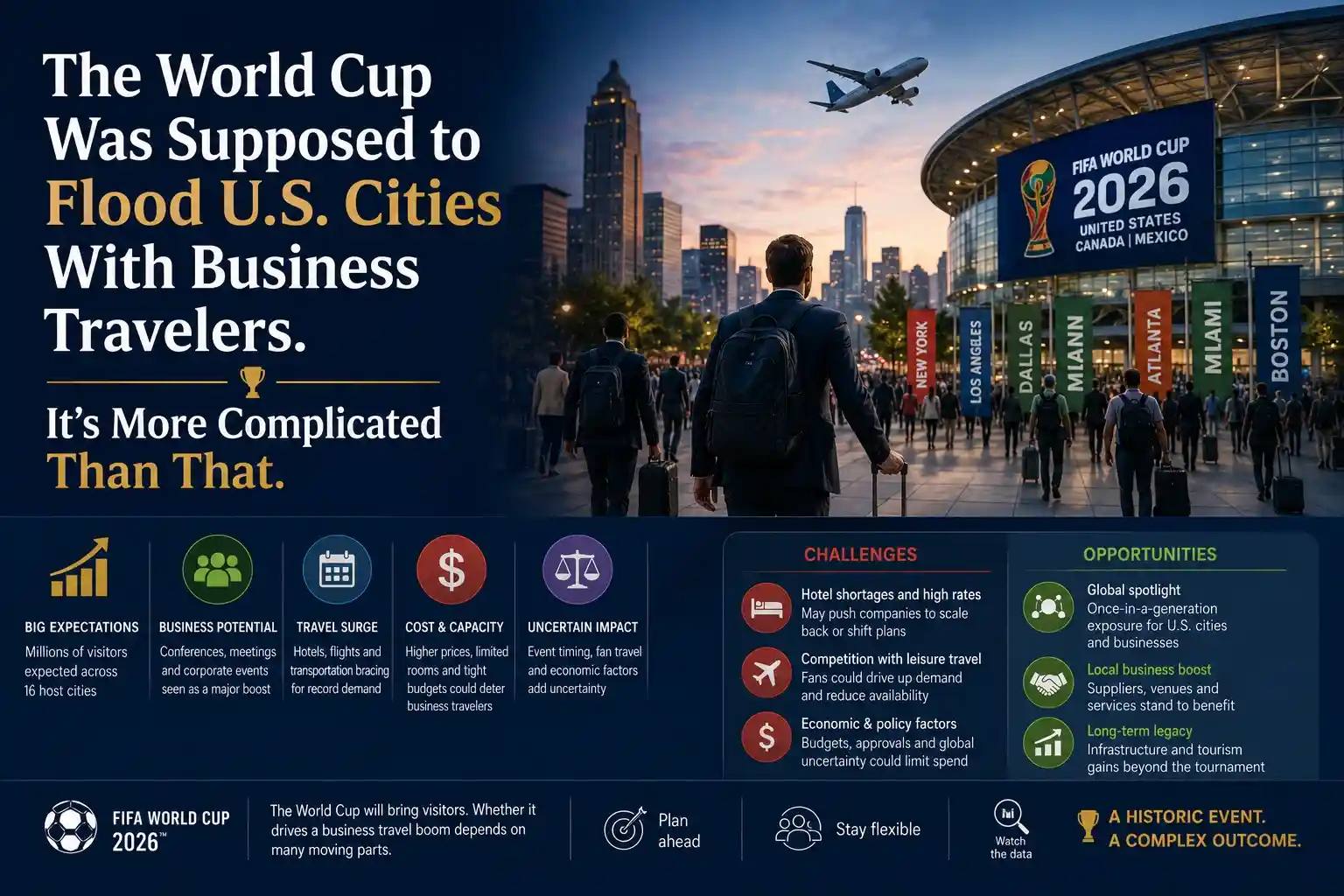
Ask a corporate travel executive in Toronto how the World Cup is going for business and you'll get a very different answer than you would in Seattle.That divergence is turning out to be the real story of the 2026 FIFA World Cup's impact on corporate travel in North America. The tournament, co-hosted by the United States, Canada and Mexico, was billed for years as an economic windfall, and in a lot of ways it has delivered exactly that. But as the group stage has unfolded, the data shows a boom that looks far less like a rising tide and far more like a patchwork of winners and losers, city by city and match by match.Corporate travel platform Navan reported that hotel and flight bookings to U.S. World Cup host cities are up 46% compared with the same period last year, driven largely by companies planning client events, executive trips and hospitality packages around the tournament. Canada's numbers are even more dramatic: corporate bookings there have jumped 295% year over year, according to Navan's data, even as flight prices in the country have actually fallen 26%. Average hotel prices in U.S. host cities have climbed 30% to $1,592 per trip, with the priciest markets being the San Francisco Bay Area, where average hotel bookings run $1,641, and the New York/New Jersey region hosting the tournament final, where the average hits $1,836."While headlines are focusing on softer-than-expected tourism demand and lagging leisure hotel bookings, our corporate data tells a different story," said Dane Molter, senior vice president of Navan Group Travel Marketplace. "Companies are embracing the World Cup as a can't-miss event and travel to North America is surging. Businesses are using Navan to lock in bookings early and control spend."The tech sector has been the biggest driver of that corporate spending, accounting for 51% of all hotel and flight booking spend in host cities during the tournament window, per Navan's figures. Professional services firms have been the fastest-growing segment, with spend up 130% year over year, suggesting consulting and services firms are treating the tournament as a rare excuse to bring clients and teams together in person.But zoom out to the reporting from CNBC in June, and the picture gets messier. Jay Wardle, president of travel data intelligence company Sojern, told the network that "demand is real and positive, but it's not evenly distributed across host cities." That's an understatement based on the city-level breakdown. Miami has seen flight bookings rise nearly 8% year over year for the tournament window, and New York is posting a similar gain. Dallas-Fort Worth is up roughly 10%, and Houston is leading the pack among the cities CNBC examined with a jump of nearly 13%.Then there's Seattle, where flight bookings are running almost 21% below last year's pace for the same period — a startling gap for a city that's supposed to be riding the same tournament tailwind as everywhere else. All three Mexican host cities are trailing their prior-year numbers as well, according to CNBC's reporting, undercutting the narrative of an evenly distributed continental boom.Part of the disconnect traces back to ticket sales. Lower-profile group-stage matches being played in cavernous NFL stadiums have proven surprisingly hard to fill, even with prices sitting at what CNBC described as Super Bowl-level scarcity. When a match isn't a marquee draw, empty seats and soft hotel demand tend to follow, regardless of how much economic hype surrounded the bid to host it in the first place.That tension between glossy top-line projections and grittier on-the-ground reality isn't new to this World Cup. FIFA itself projected $3.3 billion in total economic impact and more than 1.2 million visitors for the New York-New Jersey region alone, numbers that were widely cited when the tournament's business case was being built. But the American Hotel & Lodging Association's own "FIFA World Cup 2026 Hotel Outlook" found that expected demand hasn't fully translated into strong hotel bookings, and that domestic travelers are outpacing international visitors by a wider margin than organizers anticipated. Newsweek has reported separately that hotels in World Cup host cities are broadly underperforming relative to pre-tournament expectations, pointing to travel barriers, elevated costs and softer-than-hoped international visitation as contributing factors.Even within the corporate travel bright spots, the details reveal some interesting quirks in behavior. Navan's data shows Los Angeles emerging as the top destination for what the industry calls "bleisure" travel — trips that blend business with leisure. Saturday stayovers in Los Angeles rose from 44% to 52% of bookings, and combined hotel and flight bookings there are up 163%. Philadelphia, meanwhile, is seeing hotels booked an average of 91 days in advance, up from 59 days last year — the largest such shift among all U.S. host cities, suggesting companies there are being unusually deliberate about locking in plans early.North of the border, Toronto is doing the heaviest lifting for Canada's eye-popping growth numbers. Combined hotel and flight booking spend in Toronto is up 486% year over year, and travelers there are booking flights 119 days in advance on average, compared with 69 days during the same period last year — again, the biggest advance-booking shift Navan tracked anywhere in its data set.So which story is right — the one where corporate travel is surging on the back of the world's biggest sporting event, or the one where the promised boom has been spotty at best? The honest answer, based on the data from both Navan and outside reporting, is that both are true simultaneously, just for different cities and different companies. A tech firm sending executives to a marquee match in the Bay Area or a client dinner in Manhattan is having a very different World Cup than a hotel general manager in Seattle watching bookings lag behind last year's numbers for a tournament that was supposed to be a can't-miss economic event.For an industry that spent years building financial models around World Cup-driven demand, that unevenness is a reminder that mega-events don't lift all boats equally. Corporate travel budgets follow specific companies, specific industries and specific matches, not blanket geography. As the tournament moves from the group stage into the knockout rounds later this summer, expect that gap between winning and losing host cities to either narrow, as marquee matches draw bigger crowds everywhere, or widen further, as travel dollars concentrate even more heavily around the cities hosting the games people actually want to see.

Read Story
Business Travel Jul 03, 2026

Corporate Travel Buyers Are Bullish on 2026 Budgets, But a New Worry Is Creeping In

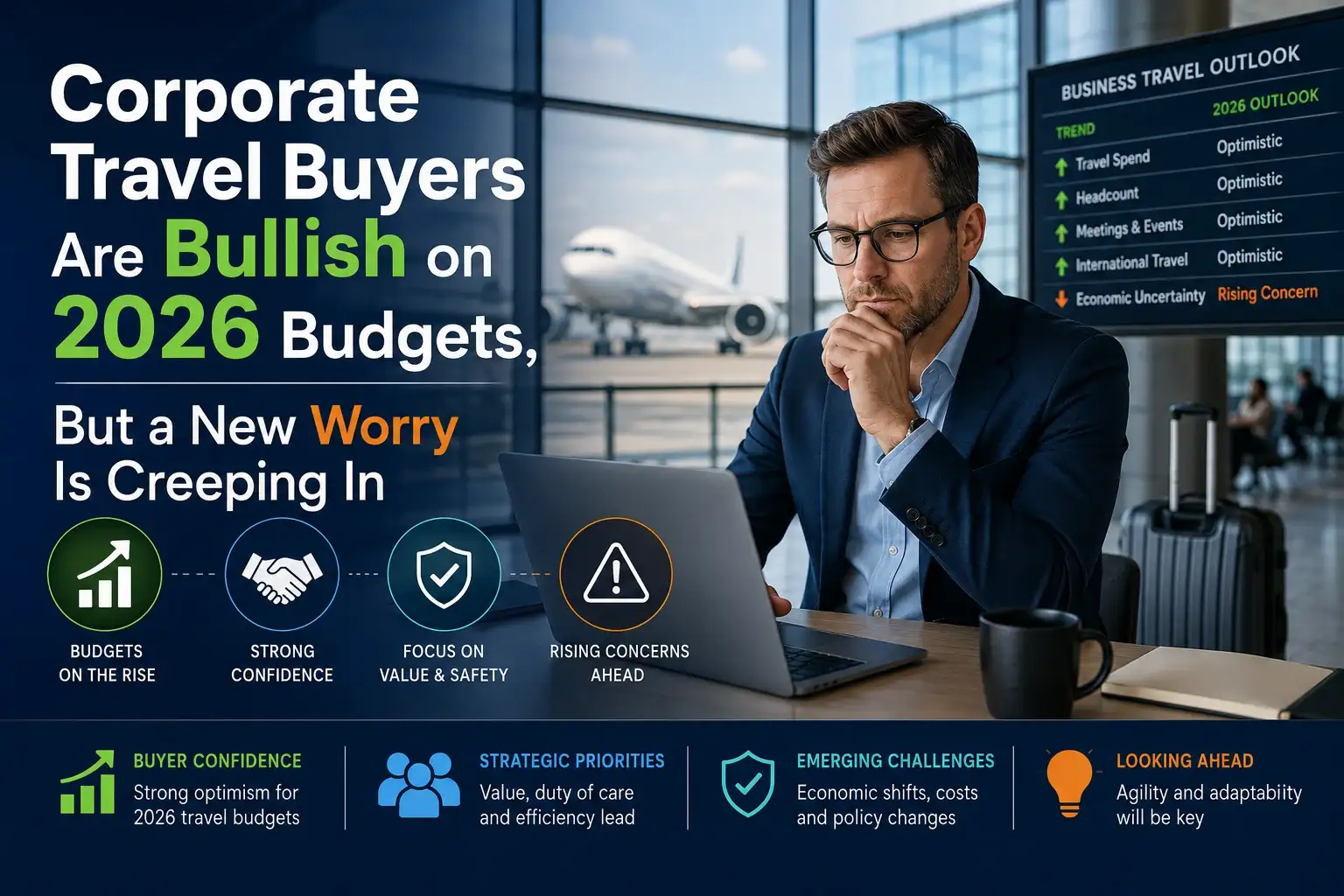
Corporate travel managers are heading into 2026 with more money to spend, but far less certainty about how smoothly that money will move people across borders.That's the picture that emerges from the Global Business Travel Association's latest industry poll, released in late January and based on responses from 571 corporate travel buyers, suppliers and travel management company professionals spanning 40 countries. The headline number is reassuring for an industry that has spent the past few years bracing for the next shock: 84% of buyers expect their organization's business travel spending in 2026 to either increase or hold steady at 2025 levels. Of those anticipating growth, the average expected bump is 12%.Dig one layer deeper, though, and the optimism gets more complicated. Only 59% of the professionals GBTA surveyed said they feel optimistic about the industry this year, and that figure represents a 12-percentage-point drop compared with where sentiment stood heading into 2025. Nearly a third of respondents describe their outlook as neutral, sitting on the fence rather than committing to either confidence or dread."The results show an industry propelled by anticipated stronger demand and financial indicators, yet potentially constrained by external factors that could reshape business travel in the year ahead," said Suzanne Neufang, GBTA's chief executive. "Traveling for work is critical to how global companies and economies grow, innovate and connect. We need to ensure it remains accessible, safe, and seamless — and that every trip counts."The poll, conducted online from January 5 to January 18, paints a business travel picture that is growing again but growing carefully. Trip volumes are expected to hold roughly steady for nearly half of buyers, with just over a third anticipating an actual increase in the number of trips their employees take this year. Among that group forecasting more travel, the average expected rise in trip volume comes in at 14%. Meanwhile, 42% of travel managers expect the number of employees traveling for business to grow in some capacity, though a third of those expect that growth to stay under 10%.Travel suppliers and TMCs, for their part, are even more upbeat about their own revenue prospects than the buyers who write the checks. Nearly half, 47%, expect revenue increases in 2026, with an average anticipated gain of 15%. But that optimism isn't universal across the supply chain — North American suppliers were the least likely of any region to predict growth, with 38% expecting an increase and 46% projecting revenue to hold flat.Money is not the only thing keeping travel buyers up at night. When GBTA asked what worries them most heading into the year, affordability topped the list at 70%, followed closely by the ease of obtaining entry and exit permissions and visas at 65%, and employee safety at 56%. Those numbers were even more pronounced among U.S.-based buyers specifically, where affordability concerns hit 76% and worries about entry and exit permissions came in at 57%.That visa anxiety isn't abstract. The poll flagged proposed changes to the Electronic System for Travel Authorization, the online system that governs entry for travelers from 42 countries that currently don't need a visa to visit the U.S. Under consideration are mandatory disclosures of long-term social media activity, contact and family information, along with the possibility of biometric selfies and a process that would only run through a mobile app. For an industry that depends on predictable, low-friction movement of employees across borders, that kind of overhaul is unsettling.Among organizations that frequently send employees to the U.S., three in four buyers said they are either very or somewhat concerned about the proposed ESTA changes. European travel professionals were particularly uneasy about the privacy implications, with two-thirds saying their employees would simply rather skip the trip than hand over that level of personal information. The ripple effects show up in planning decisions, too. A meaningful share of respondents said their companies are now more likely to hold meetings outside the U.S. altogether, decrease near-term travel to the country, or actively rewrite travel policies to limit U.S.-bound trips.Cost control remains the other persistent headache. Three-quarters of travel buyers expect their overall 2026 operational budgets for managing travel programs to increase or stay flat, but 18% are actually bracing for a decrease. U.S. buyers in particular flagged program cost savings as a bigger concern than their counterparts elsewhere, with 74% citing it compared to 62% outside the U.S. On the supplier side, the belt-tightening shows up as reduced marketing spend, hiring freezes and, in some cases, outsourcing work to vendors instead of keeping it in-house.Artificial intelligence continues to work its way into how these programs run, even if nobody is expecting it to upend the industry overnight. Pricing optimization and predictive analytics topped the list of AI priorities for 2026, cited by 65% and 64% of respondents respectively. Buyers say AI's biggest impact right now is improving internal data analysis and automating reporting, rather than replacing human judgment in the booking process. Looking five years out, more than half of respondents expect AI to deliver moderate improvements to how travel programs operate, while a smaller share, 27%, expect something more transformative.There's also a generational and regional split in how AI is being embraced. Interest in AI-driven dynamic pricing and predictive tools runs meaningfully higher outside the U.S., at 69%, compared with 59% domestically. And concerns about AI-enabled scams targeting business travelers are a bigger worry outside the U.S. as well, at 36%, versus just 14% among American buyers.Taken together, the poll suggests an industry that has largely made peace with a slower, steadier growth trajectory after the turbulence of the pandemic recovery years. Nobody in the survey is predicting a boom. But nobody is predicting a bust, either. What they are predicting is friction: friction at the border, friction in balancing traveler satisfaction against tightening budgets, and friction in figuring out how much to trust AI tools that are still relatively new to corporate travel programs.For hotels, airlines and travel management companies serving corporate clients, the poll offers a useful signal amid a lot of noise. Demand isn't disappearing. If anything, it's inching upward across most measures GBTA tracks. But the buyers footing the bill are watching costs, watching borders, and watching Washington more closely than they have in years — and that vigilance is likely to shape how, when and where business travel actually happens in 2026, regardless of what the topline spending numbers suggest.

Read Story