

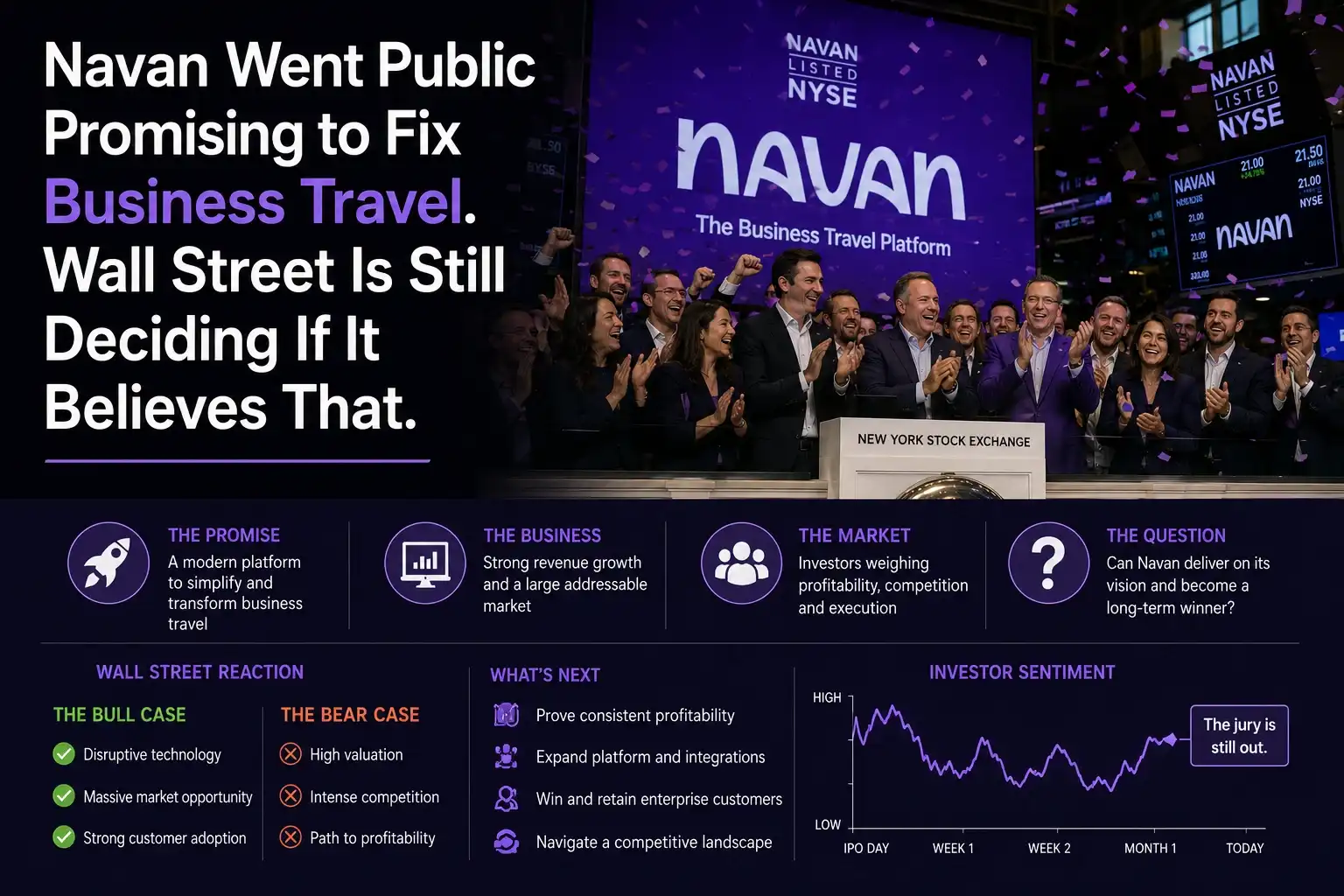
Navan Went Public Promising to Fix Business Travel. Wall Street Is Still Deciding If It Believes That.
For a company built on the promise of eliminating friction from business travel, Navan's own path to Wall Street has been anything but frictionless.The Palo Alto-based company, known for most of its existence as TripActions, filed to go public in September of last year and priced its initial public offering on October 31 at $25 per share, raising $923.1 million in what ranked among the largest U.S. technology listings of the year. The company listed on the Nasdaq Global Select Market under the ticker NAVN, with Goldman Sachs and Citigroup serving as lead underwriters. It was, by any measure, a marquee debut for a startup that had spent nearly a decade building itself into one of the more recognizable names in corporate travel management.The financial picture Navan presented to investors was one of a company still growing quickly but not yet profitable. Revenue over the trailing year came in at $613 million, up 32%, alongside $7.6 billion in total bookings, an increase of 34%. The company counts more than 10,000 corporate clients, including household names like Adobe, Blue Origin, Geico and Unilever. Net losses totaled $181 million for the fiscal year, roughly half of what the company lost the year before, though losses in the most recent six-month stretch actually ticked back up to $100 million. Gross margins told a more encouraging story, climbing from 60% to 68% year over year, a sign that the underlying unit economics of the business are improving even as the company continues to spend heavily on growth.Since that October debut, though, the stock has had a rough go of it. Shares that priced at $25 traded as low as $9.20 in early 2026, a decline of nearly 63% from the offering price. That kind of drop for a company that had been valued at roughly $9.2 billion in its last private funding round raises an obvious question: does Wall Street actually believe in the vision Navan is selling, or was the IPO simply well-timed to catch a moment when tech listings were back in fashion?The company's own answer, laid out in the letter that co-founders Ariel Cohen and Ilan Twig wrote to prospective investors in the IPO filing, leans heavily on the idea that Navan solves a genuinely painful problem. "We built Navan for the road warriors, for CEOs and CFOs who understand travel's critical importance to their strategy, for finance teams who demand precision and control, and for the assistants and program managers ensuring seamless events," they wrote. Cohen and Twig founded the company in 2015 with an explicit goal of building an alternative to legacy corporate travel and expense software, most notably SAP Concur, which has long dominated the category despite widespread complaints from users about clunky booking flows and disconnected expense systems.Technology is central to how Navan pitches itself as different. The company has built a virtual assistant called Ava that now reportedly handles roughly half of all customer service interactions, reducing the need for human agents in what has traditionally been a labor-intensive part of the travel management business. Underpinning that is what the company calls its Navan Cognition framework, which it says powers both expense compliance checks and predictive travel recommendations. The pitch to investors is that owning this technology stack, rather than stitching together third-party tools, gives Navan an edge over both old-guard incumbents and a crowd of newer challengers that includes TravelPerk, Brex and Ramp.That competitive landscape has only gotten more crowded and more consolidated in the months since Navan's filing. TravelPerk itself has been on an acquisition spree, rebranding to simply "Perk" after buying expense management company Yokoy, while a separate deal saw S4BT acquire HotelHub to create what's being described as a $5 billion corporate hotel booking platform. The broader corporate travel technology market, in other words, is going through a wave of consolidation at the exact moment Navan is trying to prove out its standalone public-company story.Navan's IPO also arrived in the middle of a broader thaw in the market for tech listings after several sluggish years. High-profile debuts from companies like Klarna, Figma and StubHub had already reopened the door for growth-stage companies to test public markets, and crypto exchanges Circle and Gemini followed with their own listings around the same period. For Navan's backers, a group that includes Andreessen Horowitz, Coatue, Lightspeed and Goldman Sachs, and which collectively poured more than $1.5 billion into the company over its history, the IPO represented a chance to finally convert years of venture funding into a liquid, publicly traded stake.Whether that bet pays off longer term may hinge less on travel bookings and more on how successfully Navan expands beyond its original category. The company has made no secret of its ambitions in payments and financial automation, positioning itself not just as a travel booking tool but as a broader platform for enterprise spending management. That's the same territory Ramp and Brex are chasing from the fintech side, meaning Navan's long-term success may ultimately be judged as much on its ability to compete with corporate card and expense platforms as on how well it books flights and hotel rooms.For now, though, the stock's post-IPO slide is the headline number that matters most to anyone tracking the company. A nearly two-thirds decline from the offering price in a matter of months is a steep drop for any newly public company, let alone one that had positioned itself as a rare profitable-adjacent bright spot in the travel tech sector. Improving gross margins and slowing losses suggest the underlying business is moving in the right direction. But public markets tend to reward growth stories with patience only when the stock price cooperates, and so far, Navan's hasn't given investors much reason to wait around.The company's next several quarterly reports will likely determine whether the market treats the IPO-day pop and subsequent slide as a temporary overcorrection or as an early verdict on how much a corporate travel platform, however well built, is actually worth in a public market that has grown far more skeptical of software growth stories than it was during Navan's earlier funding rounds.
Jul 03, 2026