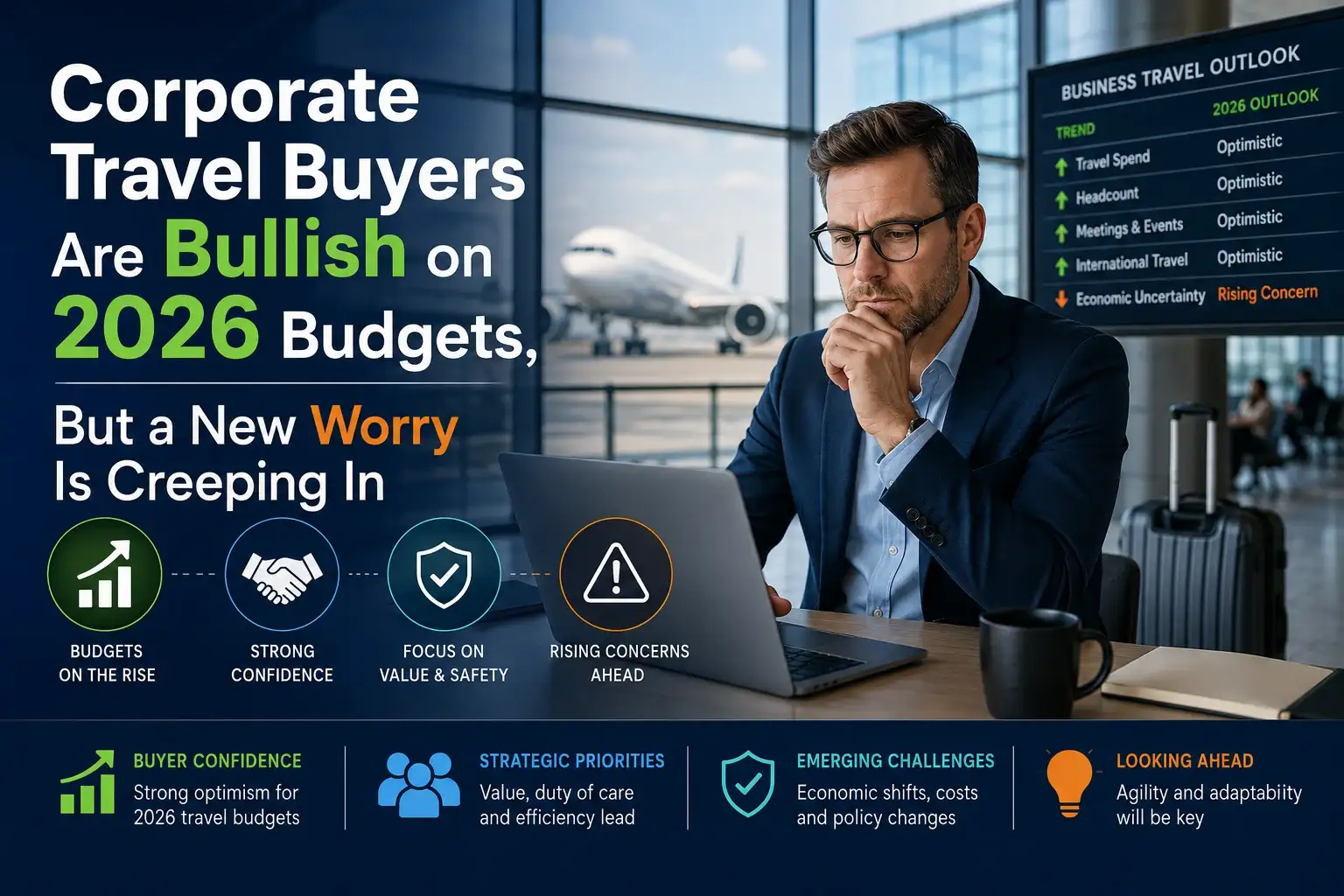
Corporate Travel Buyers Are Bullish on 2026 Budgets, But a New Worry Is Creeping In

Corporate travel managers are heading into 2026 with more money to spend, but far less certainty about how smoothly that money will move people across borders.That's the picture that emerges from the Global Business Travel Association's lat...

Published Jul 03, 2026
6 min read
Share:
Alexandria, Virginia — January 2026

Corporate travel managers are heading into 2026 with more money to spend, but far less certainty about how smoothly that money will move people across borders.

That's the picture that emerges from the Global Business Travel Association's latest industry poll, released in late January and based on responses from 571 corporate travel buyers, suppliers and travel management company professionals spanning 40 countries. The headline number is reassuring for an industry that has spent the past few years bracing for the next shock: 84% of buyers expect their organization's business travel spending in 2026 to either increase or hold steady at 2025 levels. Of those anticipating growth, the average expected bump is 12%.

Dig one layer deeper, though, and the optimism gets more complicated. Only 59% of the professionals GBTA surveyed said they feel optimistic about the industry this year, and that figure represents a 12-percentage-point drop compared with where sentiment stood heading into 2025. Nearly a third of respondents describe their outlook as neutral, sitting on the fence rather than committing to either confidence or dread.

"The results show an industry propelled by anticipated stronger demand and financial indicators, yet potentially constrained by external factors that could reshape business travel in the year ahead," said Suzanne Neufang, GBTA's chief executive. "Traveling for work is critical to how global companies and economies grow, innovate and connect. We need to ensure it remains accessible, safe, and seamless — and that every trip counts."

The poll, conducted online from January 5 to January 18, paints a business travel picture that is growing again but growing carefully. Trip volumes are expected to hold roughly steady for nearly half of buyers, with just over a third anticipating an actual increase in the number of trips their employees take this year. Among that group forecasting more travel, the average expected rise in trip volume comes in at 14%. Meanwhile, 42% of travel managers expect the number of employees traveling for business to grow in some capacity, though a third of those expect that growth to stay under 10%.

Travel suppliers and TMCs, for their part, are even more upbeat about their own revenue prospects than the buyers who write the checks. Nearly half, 47%, expect revenue increases in 2026, with an average anticipated gain of 15%. But that optimism isn't universal across the supply chain — North American suppliers were the least likely of any region to predict growth, with 38% expecting an increase and 46% projecting revenue to hold flat.

Money is not the only thing keeping travel buyers up at night. When GBTA asked what worries them most heading into the year, affordability topped the list at 70%, followed closely by the ease of obtaining entry and exit permissions and visas at 65%, and employee safety at 56%. Those numbers were even more pronounced among U.S.-based buyers specifically, where affordability concerns hit 76% and worries about entry and exit permissions came in at 57%.

That visa anxiety isn't abstract. The poll flagged proposed changes to the Electronic System for Travel Authorization, the online system that governs entry for travelers from 42 countries that currently don't need a visa to visit the U.S. Under consideration are mandatory disclosures of long-term social media activity, contact and family information, along with the possibility of biometric selfies and a process that would only run through a mobile app. For an industry that depends on predictable, low-friction movement of employees across borders, that kind of overhaul is unsettling.

Among organizations that frequently send employees to the U.S., three in four buyers said they are either very or somewhat concerned about the proposed ESTA changes. European travel professionals were particularly uneasy about the privacy implications, with two-thirds saying their employees would simply rather skip the trip than hand over that level of personal information. The ripple effects show up in planning decisions, too. A meaningful share of respondents said their companies are now more likely to hold meetings outside the U.S. altogether, decrease near-term travel to the country, or actively rewrite travel policies to limit U.S.-bound trips.

Cost control remains the other persistent headache. Three-quarters of travel buyers expect their overall 2026 operational budgets for managing travel programs to increase or stay flat, but 18% are actually bracing for a decrease. U.S. buyers in particular flagged program cost savings as a bigger concern than their counterparts elsewhere, with 74% citing it compared to 62% outside the U.S. On the supplier side, the belt-tightening shows up as reduced marketing spend, hiring freezes and, in some cases, outsourcing work to vendors instead of keeping it in-house.

Artificial intelligence continues to work its way into how these programs run, even if nobody is expecting it to upend the industry overnight. Pricing optimization and predictive analytics topped the list of AI priorities for 2026, cited by 65% and 64% of respondents respectively. Buyers say AI's biggest impact right now is improving internal data analysis and automating reporting, rather than replacing human judgment in the booking process. Looking five years out, more than half of respondents expect AI to deliver moderate improvements to how travel programs operate, while a smaller share, 27%, expect something more transformative.

There's also a generational and regional split in how AI is being embraced. Interest in AI-driven dynamic pricing and predictive tools runs meaningfully higher outside the U.S., at 69%, compared with 59% domestically. And concerns about AI-enabled scams targeting business travelers are a bigger worry outside the U.S. as well, at 36%, versus just 14% among American buyers.

Taken together, the poll suggests an industry that has largely made peace with a slower, steadier growth trajectory after the turbulence of the pandemic recovery years. Nobody in the survey is predicting a boom. But nobody is predicting a bust, either. What they are predicting is friction: friction at the border, friction in balancing traveler satisfaction against tightening budgets, and friction in figuring out how much to trust AI tools that are still relatively new to corporate travel programs.

For hotels, airlines and travel management companies serving corporate clients, the poll offers a useful signal amid a lot of noise. Demand isn't disappearing. If anything, it's inching upward across most measures GBTA tracks. But the buyers footing the bill are watching costs, watching borders, and watching Washington more closely than they have in years — and that vigilance is likely to shape how, when and where business travel actually happens in 2026, regardless of what the topline spending numbers suggest.

HospitalityAxis news delivered to your inbox

Get the free newsletter that keeps hotel developers & designers ahead of the curve.

More News & Articles

Latest Story

Deloitte's New Travel Report Has a Warning for Airlines and Hotels: The Road Warriors Are Slowing Down

The travelers airlines and hotels have relied on most heavily to prop up premium revenue may be losing some of their frequent-flyer stamina.That's the takeaway from Deloitte's 2026 Travel Industry Outlook and the accompanying Corporate Traveler Survey data behind it, which point to a meaningful cooling among the road warriors who take ten or more business trips a year. According to the survey, 53% of these frequent corporate travelers said they expected to travel three or more times in a typical month in 2026, down from 63% who said the same heading into 2025. That's a ten-point drop in a single year among precisely the travelers whose habits matter most to airline and hotel bottom lines.The reason that particular statistic matters so much comes down to spending patterns. Frequent corporate travelers, like their higher-income leisure counterparts, are disproportionately likely to book premium seats, upgraded rooms and other higher-margin products. Deloitte's report warns that if this group pulls back even modestly on both trip frequency and premium spending in 2026, the travel categories that benefited most from post-pandemic upgrade behavior "may be particularly exposed."Airlines, in particular, have leaned hard into premium cabin sales over the past several years as a source of outsized margin growth, often outpacing growth in coach revenue. Deloitte's report suggests that momentum could soften or plateau in the year ahead, which would put more pressure on carriers to get sharper about targeting the right offer to the right flyer at the right moment rather than counting on broad-based upgrade demand to keep flowing in. The hotel side faces a parallel risk: midscale and upscale resorts and city hotels could see occupancy or rate erosion if higher-income and frequent business travelers become more deal-sensitive, shorten the length of their stays, or simply take fewer trips altogether.Behind the specific travel numbers sits a broader story about consumer psychology that Deloitte's researchers describe as a widening financial split among Americans. Financial pessimism, historically concentrated among lower- and middle-income households, has crept up into higher income brackets in a way that's more pronounced than in recent years. That's producing what the report calls a growing wealth bifurcation in how people plan and pay for trips, business and leisure alike. Even affluent, frequent travelers who have the means to keep booking premium options at their prior pace appear to be second-guessing whether they should.Harvey Chipkin, writing about the findings for Business Travel Executive, summarized the risk bluntly: corporate travel may be slowing down "among highly desirable road warriors," the exact segment that travel brands have spent years building loyalty programs and premium products specifically to retain. If that segment's travel cadence keeps drifting downward, the loyalty economics that airlines and hotel chains depend on to justify premium investment could come under real strain.None of this amounts to a wholesale collapse in business travel demand, and Deloitte's broader outlook doesn't read as bearish so much as cautious. Travel remains a clear spending priority for both companies and individual American travelers, according to the report. The concern Deloitte raises isn't that people will stop traveling for work altogether, but that the growth engine that has powered the post-pandemic recovery, driven substantially by high-frequency, high-spend travelers trading up to premium products, may be running out of room to keep accelerating at the same pace.That has real implications for how airlines and hotel companies plan their next year. Deloitte's report flags competition for high-spending travelers as likely to intensify even as the overall pool of easy upgrade revenue shrinks. Ultra-luxury demand appears to be holding up better than the broader premium segment, the report notes, but airlines and hotels may need to work harder and spend more on precise targeting to capture affluent travelers who have become pickier, more price-conscious, or simply willing to trade down on any given trip.The generational makeup of who's actually driving travel demand is shifting too, according to Deloitte's outlook, and that shift carries its own implications for corporate travel programs. Gen Z and Millennials are now described in the report as defining the center of U.S. travel demand overall, shaping everything from which booking channels get used to what travelers expect from sustainability practices and how they define value versus luxury. Those two generations have kept traveling at a relatively steady clip even during periods of softer demand elsewhere, the report notes, which Deloitte suggests will increasingly influence how travel brands design products and market to travelers going forward, corporate travelers very much included as younger employees move into roles that require more business travel.Artificial intelligence is the other undercurrent running through Deloitte's 2026 outlook, and it intersects directly with how corporate travel gets booked and managed. The report describes this as a moment when generative AI tools are starting to reshape how travelers discover and purchase trips, even though fully integrated AI-powered booking experiences are still more emerging than mainstream. Deloitte frames 2026 as a potential turning point for how personalization and merchandising work in travel, a dynamic that overlaps closely with what corporate travel platforms and managed travel programs are simultaneously trying to build into their own booking tools.For corporate travel managers and the suppliers who serve them, Deloitte's report functions less as a warning of imminent disaster and more as an early signal to watch closely. A ten-point drop in the share of frequent travelers planning to hit the road three-plus times a month is not, by itself, a crisis. But it's exactly the kind of leading indicator that tends to show up in loyalty program engagement and premium cabin load factors before it shows up in headline revenue numbers. If the caution Deloitte is describing among affluent and frequent travelers persists through the rest of 2026, airlines and hotel companies that built recent growth strategies around premium upsells may need to recalibrate faster than they'd planned, precisely at a moment when GBTA's own buyer surveys suggest overall corporate travel budgets are still expected to hold steady or grow. The two data sets aren't necessarily in conflict, but they do describe an industry where the money keeps flowing while the travelers who spend it most aggressively are starting to hesitate.

Jul 03, 2026